Pillar page
Ikigai: the story behind the diagram
The accidental origin of the four-circle Venn, the East/West misunderstanding, and the diagram itself, free to use, with one small ask.
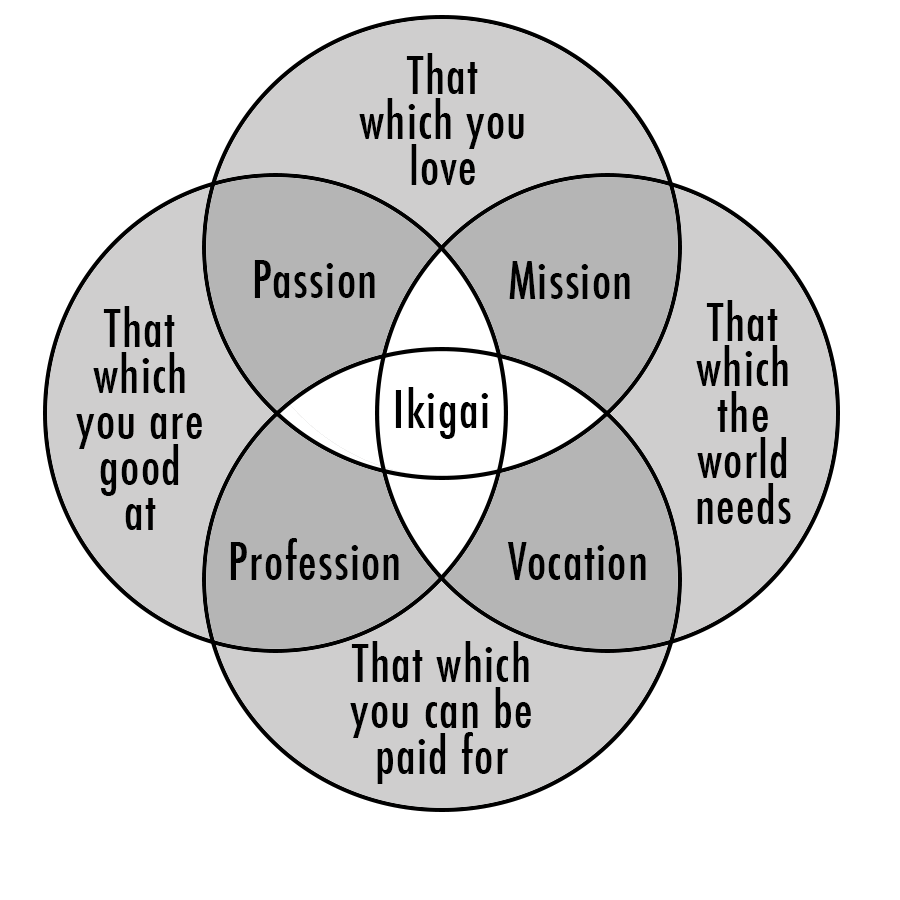
If you use this diagram, please link to this page.
How it happened
In 2014 I wrote a short blog post that mashed up two ideas I'd been chewing on: a Venn diagram that Andrés Zuzunaga had drawn about purpose, and the Japanese concept of ikigai, a reason for being, that I'd come across in Dan Buettner's work on the Blue Zones. I labelled the middle of the four-circle diagram "Ikigai" and published it under the title What is your Ikigai?
I didn't invent the diagram. I didn't invent ikigai. I just put them in the same picture, on a small personal blog, on a Wednesday morning. Ten years later the image is on TED slides, in HR presentations, on posters in coaches' offices, and, quietly, on the walls of places I've never been. It is the most viral thing I will ever accidentally make.
The misunderstanding at its heart
The diagram is useful. It is also, strictly speaking, wrong. The Japanese idea of ikigai is not a career-planning tool. It doesn't require your work, your gift and the world's needs to line up in one paid role. In Japan, ikigai is often something small and domestic, a morning walk, a grandchild, a garden, the thing that gives you a reason to get out of bed. Not a job description.
The four-circle Venn is a Western purpose diagram wearing a Japanese name. Useful. Beautiful, even. But not the whole of ikigai. The longer version of this story, how I made it, what I got wrong, and what I've come to believe it's actually for, is in The Story Behind the Ikigai Venn Diagram: A Personal Journey.
Using the diagram
You're welcome to use the image above, in slides, courses, books, on the wall of a school. There is no fee and no permission needed. The only ask is a small one: link back to this page (https://theviewinside.me/ikigai) so that anyone who finds the diagram can also find the story, and the caveat, behind it.
Further reading
- What is your Ikigai? (2014). The original post the diagram appeared in.
- The Story Behind the Ikigai Venn Diagram: A Personal Journey. The longer reflection, ten years on.
- What a diagram taught me about organisations that have lost their way. My reflection on what the diagram's reach, and its limits, taught me about organisations.
Stay in touch
What Could Possibly Go Right? Marc's weekly letter on technology, business and the strange possibilities of ordinary life. Every Friday.