The Flying Carpet and the Bath Mat
By Marc Winn

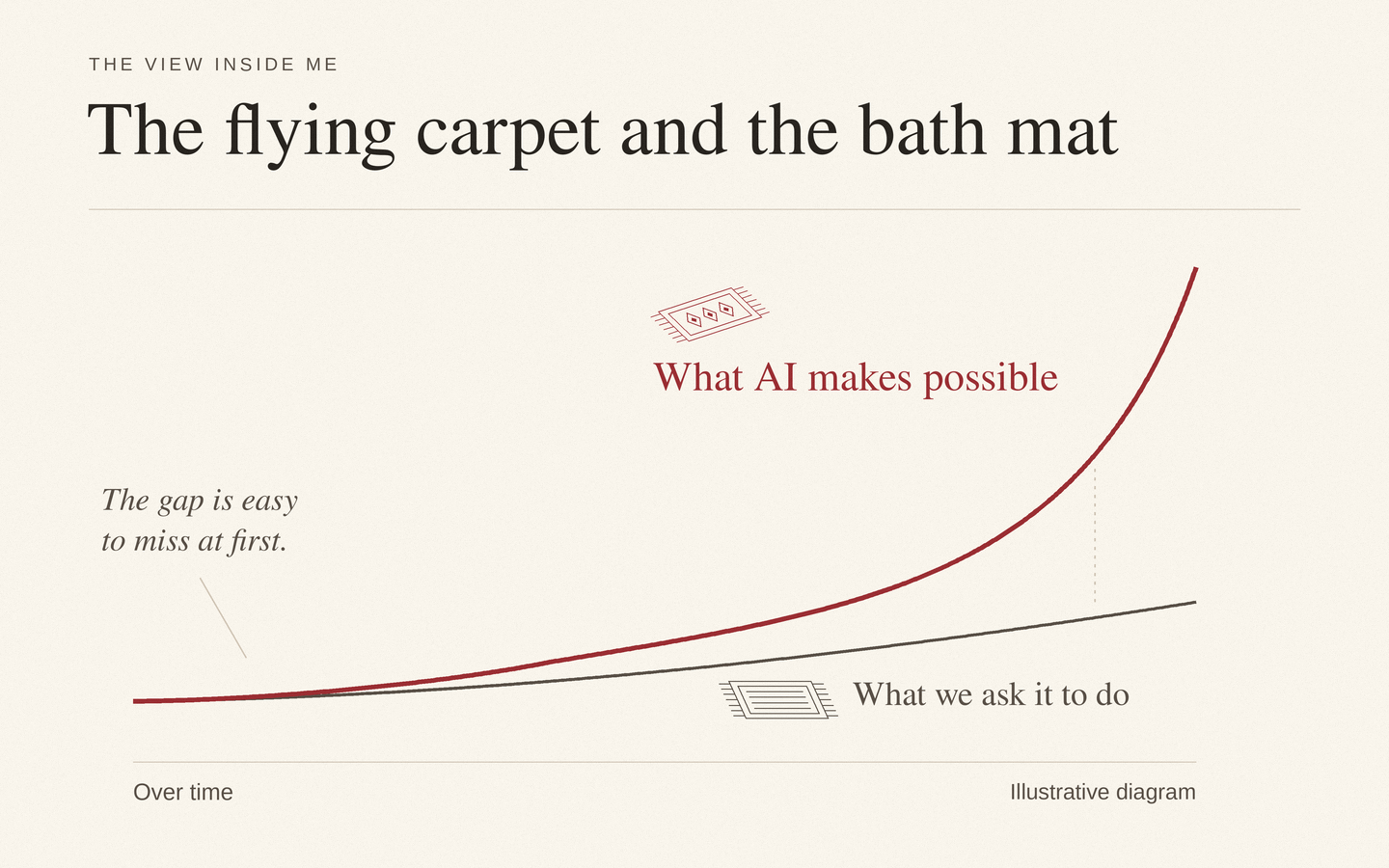
I saw a diagram that made me laugh. One line showed AI capability climbing towards the ceiling. The other showed how people were using it, ambling along near the floor. Somewhere up above were research labs and complex decisions. Down below, someone wanted a PowerPoint.
It felt like discovering a flying carpet and using it as a bath mat. A perfectly serviceable bath mat, admittedly. Perhaps the best bath mat you’ve ever owned. But you do wonder whether the ability to fly might eventually feature in the conversation.
I recognise myself in this. Give me something extraordinary and I can still find a way to squeeze it into an ordinary Tuesday. I have things to finish. People are waiting. The future will have to bear with me while I clear my inbox.
Most of us imagine change by taking what we already know and adding a bit. Next year will look roughly like this year, with a few improvements and perhaps a nicer kettle. Experience usually rewards us for thinking this way. It gives us a reasonably good idea of what to expect.
Exponential change is deceptive because, for a while, that way of thinking appears to work. Going from one to two barely gets our attention. Going from two to four still looks manageable. Keep doubling and eventually you go from 512 to 1,024 in a single step. The rule has stayed exactly the same. Each step adds as much as you already have.
Early on, it is easy to look at the curve and wonder what all the fuss is about. Most of the picture still looks flat. By the time it looks dramatic, the assumptions we made on the flat bit can be thoroughly out of date. We experience the change as sudden because that is when we finally notice it.
That is the part I keep coming back to with AI. We form an opinion, put it somewhere convenient in our heads and get on with life. “We tried it. It wasn’t very good.” A reasonable conclusion at the time. Six months later, we can still be making decisions from it while the thing we tried has changed considerably. The tools get updated more often than our expectations do.
Of course, AI’s progress is uneven. It can do something astonishing and then make a mistake that leaves you wondering whether it should be allowed near a toaster. Trust takes time. So do habits, institutions and all the other human arrangements through which a new possibility has to pass before it becomes part of everyday life. The gap between those two lines is full of people. I find that easy to forget when I’m getting excited about the upper one.
But I’m increasingly curious about what we have stopped asking for. Somewhere along the way, we learn which ambitions are too expensive, which problems are too complicated and which things require resources we will never have. We get sensible. We reduce the size of the question until it fits the life or organisation in front of us.
Then the conditions change, and we keep asking the smaller question.
This is where the flying carpet interests me. I want to know what happens when some of the things people have quietly wanted for years become possible. What do we build? What do we stop accepting? How much of the world we take for granted was arranged around constraints which are beginning to move?
I would like to leave more room for that moment. To hold my conclusions a little more lightly. To revisit a few of the things I’ve filed under “lovely idea, completely impractical”. Some of them may deserve a fresh look before I commission another five-year plan based on what felt possible last Tuesday.
The bath mat has its uses. I’d quite like to see the view from somewhere other than the bathroom.
Reader responses
Be the first to respond.