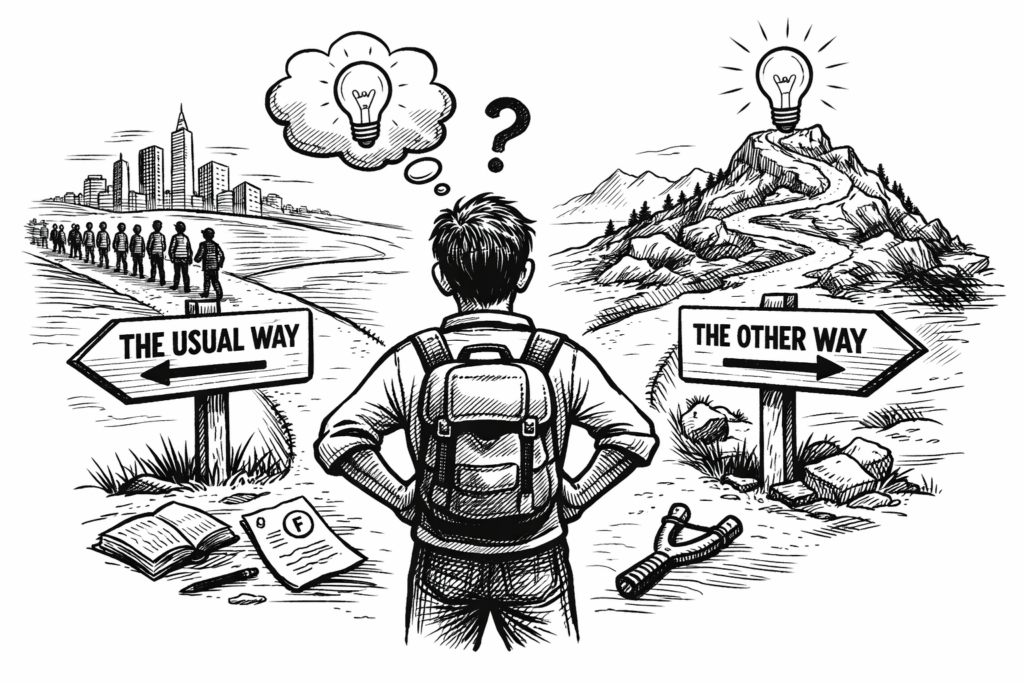
There’s a part of me that has always resisted the obvious path.
When I was younger, it wasn’t especially thoughtful. If someone told me to do something, I’d often feel the urge to do the opposite. Sometimes to see what would happen. Sometimes just to be noticed. It got me into trouble more than once.
But over time, I started to notice something underneath that instinct.
I grew up watching my dad succeed in a way that didn’t make sense on paper. He left school at 14. He was heavily dyslexic. The traditional system wasn’t built for him to do well.
And yet he did.
Not by forcing himself into that system, but by finding a different way through. He leaned into what he was good at. He trusted his instincts. He didn’t assume the “right way” was the only way.
That shaped me more than I realised at the time.
It planted a quiet doubt in anything labelled as common knowledge. Not a rejection of it, but a curiosity about where it came from and whether it still held up.
As I got older, that curiosity became more deliberate.
I became drawn to people who didn’t just improve existing models but ignored them entirely. The ones who built something new by stepping outside of what everyone else accepted as fixed.
You start to see the pattern everywhere.
The people who create breakthroughs rarely follow the most obvious route. They question assumptions others don’t even notice. They simplify things that have become unnecessarily complex. They rebuild from first principles rather than tweaking what’s already there.
It’s not about being different for the sake of it.
That kind of contrarianism is shallow and often unhelpful. I’ve done enough of that in my life to know.
The more useful version is quieter. It’s rooted in asking better questions.
Why is this done this way?
What are we assuming to be true?
If we started again, would we build it like this?
Those questions matter more now than they ever have.
We’re living through a period where change is happening fast enough to make a lot of inherited thinking obsolete. Entire ways of working are being reshaped in months. What used to be safe and proven can quickly become irrelevant.
In that kind of environment, following the crowd isn’t security. It’s often a delay.
The real advantage sits with those willing to pause and think for themselves. To step outside the noise and rebuild their understanding from the ground up.
That doesn’t mean rejecting everything. It means holding things more lightly. Testing them. Being willing to let go of what no longer works.
A lot of the work I do now comes back to this.
Helping people step back from the way things have always been done.
Looking at challenges without the weight of legacy thinking.
Creating space to see something differently.
It’s rarely about having a clever answer. It’s more often about asking a question that shifts the whole frame.
Looking back, that instinct I had as a kid doesn’t feel like something I needed to grow out of.
It feels like something I needed to refine.
There’s a difference between reacting against something and thinking independently.
One creates noise.
The other creates possibility.
And in a world that is changing this quickly, the ability to question what everyone else accepts might be one of the most valuable things we have.
Buy Me a Coffee
Did you love this article? If so please consider buying me a coffee.
Take The 50 Coffee Adventure
A Fun, Light and Easy Way to Build Connections
Or search your local Amazon store for "The 50 Coffee Adventure".
Speak Your Mind